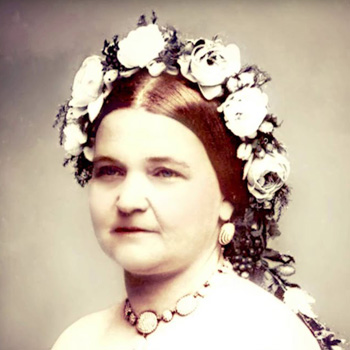
Mary Todd Lincoln
With the difficulty of making medical conclusions about Mrs. Lincoln long after she lived, precise assessment of what mental and physical problems she may have suffered is impossible. She did manifest behavior that suggests severe depression, anxiety and paranoia, migraine headaches, even possibly diabetes. Certainly all of her ills were exacerbated by a series of tragic circumstances during her White House tenure: the trauma of Civil War, including the allegiance of much of her family to the Confederacy and their death or injury in battle; an 1863 accident which threw her from a carriage and knocked her unconscious; the accusations by northerners that she was sympathetic to the Confederacy and the ostracizing of her as a "traitor" by southerners; the sudden death of her son Willie in 1862; and, of course, the worst incident of all, the assassination of her husband as she sat beside him in the Ford's Theater.
Mary Lincoln viewed her expensive 1861 White House redecoration and her extravagant clothing purchases (the former over-running a federal appropriation of $20,000 by $6,000, and the latter driving her family into great debt) as a necessary effort to create an image of the stability that would command respect not only for the President but the Union. She felt this most keenly in light of the uncertain neutrality of France and England. Public and press reaction, however, was ridicule and anger. She instead conveyed the image of a selfish and indulgent woman inconsiderate of the suffering that most of the nation's families were enduring as a result of the war her husband was managing. In time, she would even press Republican appointees to pay her debts, since they owed their positions to her husband.
By April, 1861, Union soldiers were encamped at the White House and would remain for the endurance of the Administration. The war overshadowed all of Mary Lincoln's activities. She worked as a volunteer nurse in the Union hospitals, offered intelligence she had learned as well as her own advice to the President on military personnel, recommended minor military appointments to Secretary of War Edwin Stanton, toured Union Army camps and reviewed troops with her husband. She was largely successful in her objective of using entertaining as a means of raising Union morale. It is difficult to assess the influence she had on the President, if any, but there is no record of his asking her to stop her flow of advice, recommendations and observations to him. She was not successful in her efforts to oust Treasury Secretary Salmon Chase, Secretary of State William Seward, General George McClellan and General Ulysses Grant. Numerous abolitionists, however, attested to her core value of full emancipation of African-American slaves and her influence on the President to see this not only in political but human terms as well. She considered the Emancipation Proclamation of 1863 to be a personal victory. Two public causes in which Mary Lincoln became involved attested to her genuine support of the Union Army and the freedom of slaves: the Sanitary Commission fairs, which raised private donations to supplement the federal funds for soldier supplies, like blankets and the Contraband Relief Association, which also raised private donations, for the housing, employment, clothing and medical care of recently freed slaves, an organization in which she became involved as a result of her friendship with her dressmaker, former slave Elizabeth Keckley.
Mary Lincoln was the first presidential wife to be called "First Lady" in the press, as documented in both the London Times and Sacramento Union newspapers.