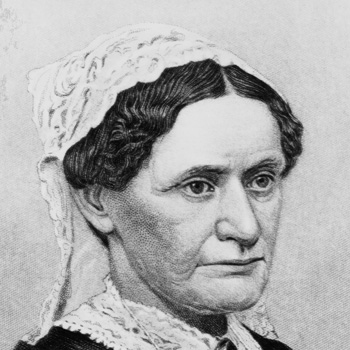
Eliza McCardle Johnson
Eliza Johnson arrived at the White House on 6 August 1865, with an entourage including her two sons, her two daughters, her remaining son-in-law and five grandchildren. Deferred to as the central figure of the presidential household, the new First Lady was given the first choice of rooms on the second floor and made the small northwest corner space her bedroom with the adjoining larger room as her sitting room. Her sitting room became the gathering place for her family.
Among the relatively obscure First Ladies of the 19thcentury, few have been left with as distorted a legacy as Eliza Johnson. Small but key pieces of new documentation as well as a closer examination of original sources which led to this misreading of her White House incumbency may offer a more indepth and nuanced perspective on her.
Contrary to later, popular perception, Eliza Johnson did assume a public role as First Lady, but she restricted it to that of hostess at formal dinners and the visits of heads of state. Martha Patterson (see her full biography below) took on the task of hostess who appeared in the receiving line at the large open-house receptions to which the general public was admitted to meet the President. Mary Stover (see her full biography below) was to assist her sister at these public receptions, but also direct the tutoring and activities of her three young children and her young niece and nephew, as well as serving as daytime aide and companion to her mother in the First Lady’s suite. Nevertheless, both daughters were led at the direction of their mother. While Patterson did assume responsibility for determining how to restore some of the mansion’s glory on a limited federal budget, Eliza Johnson still oversaw the menus for both the family’s private meals and those served to guests, making a morning ritual of visiting the kitchens and interacting with the staff. Mrs. Johnson took more than a routine interest in cooking, and the former enslaved women who worked for the family i their Tennessee home credit her with teaching them finer skills in preparing various dishes, beyond the basics. Likewise, though Stover interacted with the tutor of the presidential grandchildren, Eliza Johnson met with the children in her sitting room, after their lessons.
Certainly, Eliza Johnson’s physical condition was the most important factor determining her limited public role. Closer examination of the nature of her condition and activities during the Johnson Administration, however, refute the miscast perception of her life as being one curtailed to knitting while seated in her rocking chair, in her White House room. The source which established this skewed view, Ladies of the White House (1881) drew on an 1869 Chicago Republican newspaper account which stated: “Mrs. Johnson, a confirmed invalid, has never appeared in society in Washington. Her very existence is a myth to almost every one. She was last seen at a party given to her grandchildren. She was seated in one of the Republican Court chairs, a dainty affair of satin and ebony. She did not rise when the children or old guests were presented to her; she simply said, ‘My dears, I am an invalid,’ and her sad, pale face and sunken eyes fully proved the expression.”
Although she was First Lady before the critical momentum of the suffrage movement advocating the right to vote for women began, there is indication that Eliza Johnson believed in some degree of gender equality. Perhaps under the guidance of her mother from New England, where equal public education for female students was first enacted, Eliza Johnson was herself formally educated and insisted that both of her daughters receive that same chance, at the best possible institutions the family could afford, even though it separated her from the two girls who were, essentially, her closest friends. Further, after her daughter Martha had accepted her marriage proposal, the prospective groom approached Andrew Johnson for formal permission to marry. Johnson responded to David Patterson that, as the woman’s father, he had right to prevent or encourage what was her right to decide. It is unlikely Johnson would have so consciously expressed this unusual view had Eliza Johnson not fully shared it.