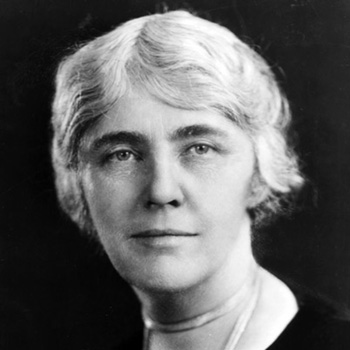
Lou Henry Hoover
Despite her enormous record of activism, public speaking, fundraising, and acute degree of conscientious professionalism in all that she did, upon becoming First Lady Lou Hoover decided to restrict the degree of what had been an adult life of public activism. She did this on the premise that she would be expected to behave publicly in a way that did not defy the feminine traditional decorum associated with her new status. Seemingly overnight, her words and deeds assumed a previously unseen subdued nature.
Unquestionably the single greatest incident that influenced her to maintain her initially cautious approach was the massive failure on Wall Street that occurred just six months into the Hoover Administration. The full measure of the Great Depression's impact did not immediately affect the nation as a whole; rather, it unfolded over time with every hope that the economy would correct itself. With each ensuing month, however, came greater unemployment and eventually loss of income and home. Behaving in a way that might strike the public as aberrant rather than serve to provide a steadying perception became a guiding principal for her as she made decisions of what to do or not do as First Lady.
Within these parameters, however, she initiated numerous innovations that truly helped to modernize the public role of a First Lady and extended it more overtly into the public realm than it had ever previously been.
Nevertheless, she made one immediate innovation that set a precedent which her successors followed or were criticized for not doing: she continued to deliver speeches not only in auditoriums but to also give public addresses over the radio. Just over a month after becoming First Lady, her brief 19 April 1929 speech to the Daughters of the American Revolution was carried on the radio.
Mrs. Hoover took her "talkie voice" seriously enough that she had a recording system set up in the White House enabling her to replay her recordings and test the pitch, tone and pacing of her voice. With a great interest in the popular films of her era, Lou Hoover had equipment placed in the oval room of the family quarters to screen sound motion pictures for her guests, the equipment and installation donated by a Hollywood studio.
No single event more defined and overshadowed the Hoover Administration than the dramatic drop of the stock market in October of 1929. Beginning what would soon be known as the Great Depression, it was a time of unprecedented loss of stock market investments, business failures, factory closings, housing losses, and mass unemployment. As it worsened over the course of the Hoover Administration, the lack of earnings began t hit American families of all classes; those without substantial cash savings or the prospects of employment were often unable to afford the most basic needs of food, shelter and clothing.
n the autumn of 1932, Lou Hoover accompanied the President for six weeks of his whistlestop re-election campaign, along some 12,000 miles through Ohio, Indiana, Illinois, Iowa and Pennsylvania. Occasionally she made impromptu remarks to crowds from the back of the train although no record of her remarks has been preserved. However appalled she was when they were confronted with jeers from those opposing him, she never acknowledged them in public. She herself was the target of anti-Hoover sabotage that autumn when, as she addressed an 8 October 1932 Girl Scouts convention in a speech that was to be carried live over the radio, the wires were cut by someone and the transmission failed.
The unrelenting attacks on her husband for the Depression and his failed re-election in 1932 left Lou Hoover uncharacteristically bitter. After she died, her husband would write that, "She was oversensitive, and the stabs of political life which, no doubt, were deserved by me, hurt her greatly…" One of the first systematically-organized smear campaigns against a President, however, had been orchestrated against Hoover, much of it based on either outright falsehoods or the most negative interpretations possible just short of libel.
Lou Hoover's perspective was insulated by the comfort of her wealth. Having encouraged Girl Scout membership from all socio-economic levels, there were undoubtedly hundreds of them whose own fathers were unemployed or whose families suffered from the Depression. In her hopes that women would consider pursuing jobs or volunteer work outside of the home, in addition to their roles as wives and mothers, she expressed exasperation that some who claimed their responsibilities to young children prevented this were simply "lazy." Yet within her own life experiences and those accomplished women in whose circle she moved, Lou Hoover failed to recognize or acknowledge how wealth afforded a wider range of choices. Not every woman could afford nurses, cooks or maids to care for children, to clean and prepare meals. In her hope to stimulate the cotton industry by getting women to wear that fabric in their evening clothes, she failed to recognize that most American women had neither the need nor the funds to purchase a gown, regardless of the fabric it was made from.