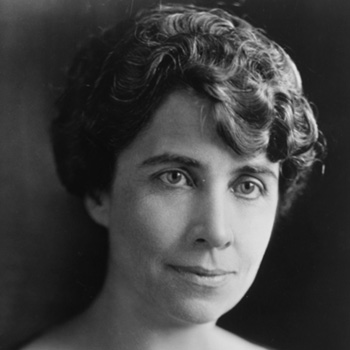
Grace Anna Coolidge
Grace Coolidge, although not particularly a student of history, was among the earliest First Ladies to have a grasp on the evolution of her unique role within the American popular culture, especially in terms of how it limited her own activities. As she wrote with insight: “There was a sense of detachment – this was I and yet not I, this was the wife of the President of theUnited States and she took precedence over me; my personal likes and dislikes must be subordinated to the consideration of those things which were required of her.”
Grace Coolidge maintained a friendly relationship with two of her predecessors who also lived in Washington throughout her incumbency as First Lady; Helen “Nellie” Taft, whose husband, the former President, was by then the Chief Justice, and Edith Wilson, whose husband died six months after the Coolidge Administration began. She was among the first of First Ladies to pursue a study of her predecessors, writing that, “Since I went to the White House, I have read eagerly everything that I could find concerning former mistresses of the mansion and have regretted that there was so little.” Interestingly, Calvin Coolidge appears to have been the first U.S. President to write about the role of First Lady: “The public little understands the very exacting duties that she must perform, and the restrictive life that she must lead.”
It was ironic that Grace Coolidge would be among the earliest First Ladies to initiate federal legislation, for she was otherwise removed from the political realities of her husband’s position. It was not for lack of interest in, or ignorance of social issues or political policy which curtailed Grace Coolidge from expressing her views in public but rather the determination of the President that it would improper for her to do so. Several factors may account for this. For example, the First Lady’s public display of interest in the Senate investigation of questionableTeapot Dome oil leases and potential bribery of Harding Interior Secretary Albert Fall by attending the hearings and following the detailed proceedings.
In private, she may have also exerted some degree of influence on matters she knew were under review by him or others. There is one incident which revealed this, stemming from her admitted advocacy of the Public Buildings Act, which permitted for the review and coordination of architectural plans of federal structures, based on quality of design aesthetics. When the Commission on Battle Monuments chairman presented a draft of plans for an intended memorial to the President, the First Lady interceded during the meeting, making the case that the rectangular shaft more resembled a guillotine. Her judgment overrode that of others and the architect was ordered to draft a new design.
Unlike most of her predecessors, Grace Coolidge displayed enthusiasm for keeping current with evolving technology during her tenure as First Lady. She was an avid and early user of the radio as both a form of entertainment and news. She listened to her radio each morning in the White House, working alongside her secretary. She recalled one of her most memorable moments as being one which found her listening to music being transmitted from a far distance on the radio, while watching the famous Graf Zeppelin sailing overhead.
There is one potential inconsistency in her purported divorce from the President’s decisions. When U.S. Senator Arthur Capper (Kansas) suggested that she had previously known about the President’s decision to not seek re-election in 1928 before he publicly announced it on 2 August 1927, Grace Coolidge reacted with surprise – not of his suggestion but of his revelation. She claimed that not until Capper mentioned it did she have any idea that the President would make such an announcement, which occurred while she was out walking in a remote wooded area with no access to the breaking news. She used this story to illustrate her claim that the President did not seek her opinion on decisions he made which, though having a public impact, more directly affected her personal life. Consistently honest, there was no reason to doubt her claim; her completion of a Lincoln Bedroom quilt into which she had sewn in the completion year of the Administration, however, occurred before his announcement. It may be that he had privately assured her he would not run but had not entirely committed to his decision when he told her this. It is also claimed that she casually remarked to a friend that her husband “says a depression is coming” upon leaving the White House; if true, it also suggests that she kept abreast of internal political matters to a greater degree than perhaps even her husband realized.