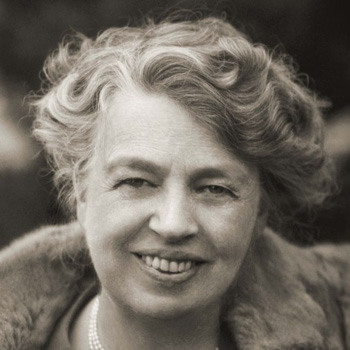
Anna Eleanor Roosevelt
No presidential wife served as First Lady for a period longer than did Eleanor Roosevelt – twelve years, one month, one week and one day. No First Lady served through two nationally traumatic events such as did Eleanor Roosevelt, presiding at the White House during the Great Depression and World War II. Unique to her tenure was the fact that the President was physically limited by his then-hidden condition of polio. Thus apart from finding a way to integrate her own professional interests and experiences into the public role of First Lady and assume the traditional management of the mansion’s functioning as a political-social arena, Eleanor Roosevelt worked closely with the President and his staff as an unofficial Administration representative and on policy-related issues.
Perhaps there was no more important decision among her initial deeds as First Lady than her decision to continue her work as a writer, public speaker and media figure. It helped in her mission to inform the public, provoke discussion and debate on conversation, rally public support for efforts she believed in or promoted as part of the Administration. It helped to forge a permanent image in the public mind at the time of not just Eleanor Roosevelt as a distinct personality but to shift the perception of what “First Lady” could mean.
On many occasions, Eleanor Roosevelt found that a subject she felt required closer consideration was best served by her writing about it in a lengthy magazine article. She had no one exclusive contract with a publication, giving her the freedom to choose specialized venues to reach target audiences. She addressed the moral necessity of civil rights, for example, in magazines ranging from The Saturday Evening Post to The American Magazine to The New Republic.
Eleanor Roosevelt had nearly a decade of experience as a radio commentator by the time she became First Lady. During the transition, following the 1932 election, she contracted to deliver twelve radio news commentaries for the Pond’s cold cream company. In 1935, she contracted with a roofing company at $500 a minute, and subsequently for a mattress company, typewriter and shoe company, doing various series of multiple broadcasts on different subjects like higher education or events in the news. Despite editorial criticism that it was undignified for the president’s wife to undertake such overtly commercial ventures, she would continue to do them as First Lady, claiming she was motivated to do so because it permitted her to continue raising large sums she donated to charities.
Among a network of women who had mostly been professional educators, journalists, attorneys, and union leaders in the reform movement during her previous years in New York or who had worked in the Democratic Party at the national or New York state level, Eleanor Roosevelt was the central figure. She worked closely with her friend Molly Dewson, who ran the National Democratic Committee’s Women’s Division, to integrate as many qualified women into the Roosevelt Administration and the federal government in high- and mid-level administrative posts.
By 1933, Eleanor Roosevelt’s views had evolved to the point where equality of all races had become one of her core values as a person. Far more than her husband, she believed the U.S. government had a moral duty to initiate and enforce changes that furthered or ensured racial equality. The larger white population at that time as nothing short of radical viewed this, yet it never persuaded her to restrain her words and deeds. Often it was a singular, unambiguous action intended as a symbol that prompted a public facing of the issue. She showed her opposition to segregation laws when she came to the Southern Conference for Human Welfare in November of 1938, in Birmingham, Alabama and moved her chair into the aisle, between the “whites-only” and “colored-only” sections. Invited to the African-American Howard University, for example, she wanted herself photographed as two uniformed male honor guards escorted her in. The picture was widely printed, often used to prompt angry racist attacks on her.
Eleanor Roosevelt was a strong supporter of labor unions, though she refused to be seen as a foe of industry. Instead, she sought to encourage mediation over striking. As a working newspaper columnist, Eleanor Roosevelt joined the American Newspaper Guild, the first known First Lady to join a labor union. She would be elected, on a write-in vote, as a delegate to the local Industrial Union Council but with the charge that communist interests dominated the organization, she declined and privately urged the guild to disassociate with the council.
Although Franklin and Eleanor Roosevelt maintained increasingly separate orbits of activities and friendships as the Roosevelt Administration would proceed, they remained mutually committed to each other as partners with a loving past, and continued to share the same general values in terms of how to best get the nation through the Great Depression and then World War II. They continually maintained a dialogue on immediate and long-term domestic and international crises. After nearly all of her fact-finding missions across the country, she reported all the important details she knew would either interest him or provide insight into the mood of an individual or demographic she had met with, often providing her own analysis of their remarks or reactions. This was a continuation of her “eyes and ears” role begun when he was Governor of New York.
erhaps the most historical of Eleanor Roosevelt’s radio broadcasts was the one she did on the evening of December 7, 1941. Earlier that day, Japanese air forces bombed the U.S. naval base at Pearl Harbor, Hawaii. During the day, within hours of the attack, the entire nation heard the news that all knew would inevitably mean U.S. involvement in the world war. It would not be another full day before the President addressed the American people in his declaration of war before Congress against Japan and its allies. Thus, it was Eleanor Roosevelt who became the first national figure who spoke with the people about what this would mean, in terms of the changes of normal life and particularly for women and young men of enlistment age.
Like presidential daughters dating back to Martha Jefferson Randolph, Anna Roosevelt Dall Boettiger [Halstead], served for a period of several months as an unofficial surrogate First Lady. Unlike other First Daughters who assumed entirely the public role of hostess at White House events like state dinners and receptions, the duties assumed by Anna Roosevelt were both wider and narrower in scope. Since she served as a surrogate First Lady towards the end of her father’s presidency, as well as his life, and as World War II was accelerating towards its end, Anna Roosevelt’s importance to the Administration was less as a public hostess and more as a manager of the President’s private social life, which inevitably blended with his perpetual state of work.