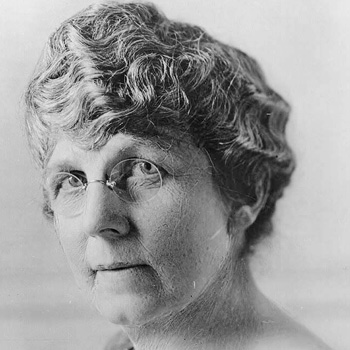
Florence Mabel Harding
With her public image already cast from the campaign, Florence Harding continued to strike a duality as a modernist and traditionalist. She was one of the earliest First Lady to feel that the citizenry were her constituency and her role entailed more than hostess in the White House. "I feel that there is a great duty and responsibility which I must live up to," she explained.
Florence Harding was "particularly anxious…to help the women of the country to understand their government…I want representative women to meet their Chief Executive and to understand the policies of the present administration." She invited not only women's political groups but also women federal workers, girls graduating from high school, college girls, and even African-American girls from local Dunbar High School. She broke an unwritten social code and invited divorced women to social events. While she did not publicly address the issue of birth control, she refused to condemn the movement for it when pressed by a reporter.
The First Lady also shared a vision for a "community of women working together under the guidance of other women," and supported a prison reform movement that grew from the harsh experiences of women suffragists in prison. A diverse consortium of women's groups that Florence Harding supported, including the American Association of University Women, the National Federation of Business and Professional Women’s Clubs, the American Federation of Teachers, the Daughters of the American Revolution, the League of Women Voters, and the national Women’s Christian Temperance Union sought to protect women inmates from the exploitation of male inmates and staff and to provide a communal setting with provisions for nurseries and childcare to imprisoned women. It would result in Alderson Reformatory Prison, the first federal correctional institution exclusively for women prisoners, located in West Virginia. It emphasized rehabilatation to give skills to women to earn their own living "without dependence on a man or the community." In February of 1923, Florence Harding disclosed to women reporters that she was then lobbying Republican House Majority Leader Franklin Wheeler Mondell of Wyoming, over whom she had considerable influence, for a bill to fund Alderson.
Florence Harding's work on behalf of World War I wounded veterans was as personal to her as it was political. She recalled her own long convalescences from illness as the root of her empathy for the hospitalized serviceman and she fully dedicated herself to every aspect of their well-being and care: visits to hospital wards, using all federal agencies within her power to resolve disputed, individual cases, veteran benefits, and ward transfers. Her symbolic acts and personal appearances were the public face of it, but she also worked privately, and prompted federal action. Her visits to the men she called "my boys" at Walter Reed Hospital's Red Cross Convalescent Home were made several times a week, and often she was photographed talking to them, or visiting vocational facilities to prompt public interest. Yet she also made the visits without any public notice, often after dinner and took notes on their needs or problems. She hosted famous garden parties for thousands of the disabled men from area hospitals and care centers. She invited a famous doughboy to first sing at the White House before he began a national tour of veteran hospitals. Whenever she traveled around the U.S., Florence Harding would visit wards for those suffering from mental trauma, tuberculosis, blindness, or missing limbs all resulting from the war. She headlined a "Lest We Forget" Week to prompt donations of clothing, books, records and other items needed in the wards. If she noticed any veterans on crutches when she was being driven somewhere, she had her car stopped and the veterans given a ride to wherever he was headed. She led a national effort to create a monument to the World War I soldiers on the National Mall.
On international affairs, Florence Harding was more cautious. She led a national relief effort following the Armenian genocide of 1915 but feared that aiding an effort to find housing for Irish families displaced by the British Army during the "Easter Revolution" for independence would be seen as anti-British by the State Department. Privately, as documented in a State Department memo, she vigorously opposed Commerce Secretary Herbert Hoover's famine relief effort in Russia until its Bolshevik leaders had pledged to reject communism.
It was Florence Harding who had insisted that the trip to Alaska be made, it being a long-held ambition of her's. It had been previously scheduled and postponed but now that she was recovered, definitive plans were made, even in the face of the President's obviously failing health. Naval physician Joel Boone kept a handwritten diary when he came to serve under Sawyer in care of the Hardings. He was alarmed by Harding's enlarged heart and general condition, as were others who advised against the trip. If Florence Harding had specific fears stemming back to the astrological prediction that Harding would not survive his term, she nevertheless pushed for the trip. Shortly after the election, she had consulted a new astrologer, a Mrs. Joseph in Cleveland, who assured her he would not meet his demise as the earlier astrologer had warned her. Seemingly by miracle she had been returned from what she vividly described as a near-death experience by the in competent Sawyer, in whose medical powers she now placed her full trust in his care for the President.
As the Hardings went out across the country with numerous stops in the Midwest and West, Florence Harding's popularity increased. She insisted on fulfilling all of the scheduled appearances despite its obvious toll on Harding. In Alaska, Florence Harding spoke openly to the press of her belief that the territory was ready for statehood. Under Sawyer's care, Harding was nevertheless weakened, yet made to climb endless steps. Shortly after the President sampled some seafood - widely reported to be crab - and had returned to the U.S. mainland, he fell ill. The train was sped down the west coast, headed to San Francisco. Florence Harding made occasional speeches from the back of the train to gathered public groups.
Among the few remaining medical records kept by Boone of Harding's illness was a scribbling that indicated the President had been given digitalis for his heart. Sawyer also told the press at the time that he administered some unnamed stimulants to Harding. Documentation from other doctors in attendance, conflicting details given out by Sawyer to reporters who gathered in the hotel for news, and Florence Harding's panicked yell for Boone support the theory that the near-blind and incompetent Sawyer may have accidentally induced the heart attack that killed Harding on 2 August 1923. By all contemporary accounts, Sawyer had an enormous power over Florence Harding, and her refusal to permit an autopsy or even a death mask may have been to protect his credibility.