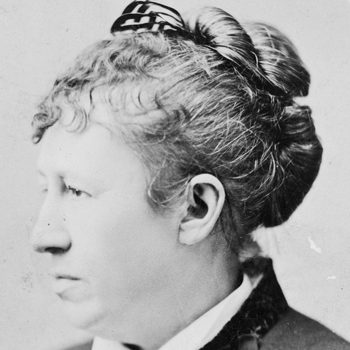
Julia Grant
Julia Grant recalled her eight years as First Lady with the same lavishly romanticized metaphor of a flourishing garden of delights that she used in remembering her childhood. It was not merely the privilege of living in the Executive Mansion and its inherent right to decorate the public rooms and entertain at formal functions, but also the adulation she received personally when she made public appearances, a role she especially relished. Although press and public acknowledgement that women married to or serving as an official hostess to an President held a unique, national status began with Martha Washington at the presidency’s inception, few of the previous women so entirely embraced this as did Julia Grant and none for as long a period. There was also novelty for the public in having a president’s wife solely assume the First Lady role for eight consecutive years; the last time such a situation has occurred was over a half a century earlier when Dolley Madison ended her White House tenure in 1817.
By her spoken and written remarks, Julia Grant indicated her belief that, by virtue of the fact that she was married to the President, she was herself a unique public figure; it may well be that implicit in this sense of entitlement was that she had earned it by the sacrifice and hardship she endured through the entirety of her marriage, for the sole purpose of supporting and defending her husband. However, since Julia Grant always cautiously avoided leaving too detailed a record of any suffering she had endured on behalf of her husband, her sense of self as a rightful public figure was often perceived as a naively arrogant suggestion that she was a queen of a democracy. In truth, she was highly conscious of the fact that any public glorification or condemnation that she personally received was a form of reflective honor or insult to her husband. She believed firmly that, apart from his glorious military career, Ulysses Grant was destined for the presidency, based upon a prophecy made by her mother in the 1850s that this “little man will fill the highest place in the government….He is a great statesmen.”
If she viewed her role as one worthy of public respect, there was also, however, a sense that Julia Grant did not always align it with a sense of obligation of public sacrifice, readily accepting gifts and offered privileges without considering the public reputation of the donor or acknowledging even the potential appearance of conflict of interest. The Attorney General’s wife, for example, believed this was due to the fact that, protected by the chivalrous protection of women, she had never been “taken down,” for her acquisitiveness or held responsible for her choices, finding her "simplicity itself almost flat sometimes…impulsive and governed by her prejudices.” Still, she concluded, “one cannot help liking her because she is so genuine."
In following her own wishes, Julia Grant both broke and set new social precedents. She ignored the traditional customs that forbid Presidents and their spouses from dining in private homes outside the White House or in public restaurants. She encouraged working-class government clerks to feel comfortable in attending her public receptions. Since she often was unable to recognize important figures by sight or recall their name and rank, she began the custom of inviting the wives of Cabinet and Senate members to receive alongside her and introduce for her those more familiar to them. On occasion, her impulse to engage in friendly small-talk posed potential social embarrassment when she encountered important figures who held orthodox views on social issues. Early on, she came to depend on the seasoned social savvy of the Secretary of State’s wife Julia Fish.
With evidently more frequency than any of her predecessors, Julia Grant made frequent trips that included public appearances outside of Washington both on her own and with the President. Mrs. Grant also accompanied him on most of his regional tours, to New England, the Mid-Atlantic and the northern Midwest. During such public appearances, she also refused to curtail her activities based on assumed societal propriety. In the fall of 1869, for example, she took over the reins of horses pulling the presidential carriage, to test their speed from Pennsylvania to West Virginia.
The degree of influence over the President which the First Lady sought to exercise was never motivated by any personal agenda of her own but rather driven by what she believed was either in his best interests or to help individuals who in some way appealed to her in a personal way. As far as matters about which he sought her advice, she was said to encourage him to do what he knew was the “right” thing, especially when it concerned the fate of individuals and, perhaps at time, induce him to do so.
As late as December 1873, the Washington Evening Star still referred to her with the old-style title of “Mrs. President Grant,” but by January 20, 1875 a Honolulu publication described her as “first lady in the land.” At the time, American newspapers such as The Saline [Kansas] County Journal, such as in its September 24, 1874 edition, had begun to also make reference to Queen Victoria as the “first lady in the land” of England. There was also a Washington correspondent who covered social events with the nom de plume of “Mrs. Duffy,” who declared that the wife of the Chief Justice must be called the “first lady.”
As late as December 1873, the Washington Evening Star still referred to her with the old-style title of “Mrs. President Grant,” but by January 20, 1875 a Honolulu publication described her as “first lady in the land.” At the time, American newspapers such as The Saline [Kansas] County Journal, such as in its September 24, 1874 edition, had begun to also make reference to Queen Victoria as the “first lady in the land” of England. There was also a Washington correspondent who covered social events with the nom de plume of “Mrs. Duffy,” who declared that the wife of the Chief Justice must be called the “first lady.”