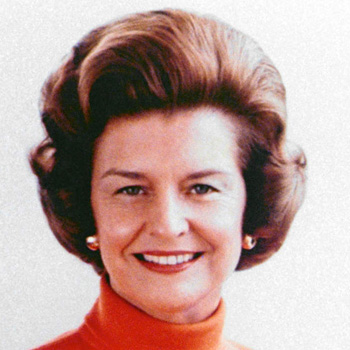
Elizabeth "Betty" Ann Ford
Just as she had been thrust into the role of a political spouse just two months after her wedding in 1948, Betty Ford was thrust into the role of First Lady with no time for planning any goals or agenda. In fact, within two weeks of her assuming the position she had a state dinner to arrange for the King of Jordan. The press and the public were immediately enamored with Betty Ford and her family; less than a year earlier, they had been living a scenario that essentially mirrored the middle-class existence of most Americans. Their phone number had been listed. Their garage was filled with sports gear and lawn care equipment. They were concerned how they’d put all their children through college as the national economy endured an economic recession. Among the family, this personal side of the new presidency was transmitted primarily by Betty Ford in simple, honest conversation in interviews, speeches and responses in a rare press conference by a First Lady, conducted on 4 September 1974. At that press conference, the new First Lady announced areas of interest that she would foster, such as the performing and fine arts, and disabled children. However, she also reiterated her support of the Equal Rights Amendment and the Supreme Court decision in favor of legal abortion, and her having divorced and having consulted a psychiatrist. These were extremely rare expressions not only of a First Lady’s genuine opinion on controversial domestic issues of her time, but also of personal revelations the likes of which had never before been disclosed by a First Lady. Two dramatic events that occurred within three weeks of the press conference, however, eclipsed any further indepth coverage of the issues Betty Ford raised in her press conference.
On 26 September, 1974, Betty Ford was diagnosed with malignant breast cancer during a routine mammogram at Walter Reed Army Hospital. She and her husband kept it secret until two days later, when the First Lady underwent a mastectomy. In consideration of President Ford’s vow that his Administration would usher in a new post-Watergate era of White House honesty, Betty Ford made the unprecedented decision to be entirely forthcoming about her health condition. It was while hospitalized, as she looked out the window at the heavy international media presence there to report on her that she realized what she called the “power” of the First Lady’s role to create change and influence behavior. Indeed, as the details of her breast cancer were disseminated in the wake of her disclosure, there were widespread reports of tens of thousands of American women seeking to also have mammograms. Although no definitive numbers can be documented, it is a safe assumption that Betty Ford’s decision to openly discuss a health issue had saved the lives of untold individuals, whereas previous generations of women had lived with it in secret shame. Her direct usage of the very words “breast” and “cancer” was something that had rarely been done in the past. By further using her own condition to discuss screening diagnosis, treatment options and the emotional process of surviving a mastectomy, she not only raised public awareness but forever changed the perception of the disease. As an individual who had gone through the process, she further became an example and symbol for those who had also faced or were just then facing breast cancer. Finally, it was also the first time a First Lady had permitted reports of her own medical condition to be publicly released since Florence Harding had done so in 1922. With her cooperation, a complete account appeared in the 7 October 1974 issue of Newsweek magazine. Some sixty thousand letters came to the First Lady, many with contributions which she donated to the American Cancer Society.
According to their son Jack, Betty Ford not only read through the President’s briefing papers on political issues he faced, and reviewed with him those pertaining to social programs or any which affected women. She also quietly worked as a conduit on legislative and other domestic agenda issues, both to and from him to others. Although she refused to ever discuss what issues they may have disagreed on, she did admit to serving as what she called, a “sounding board,” and exercising “pillow talk” on occasion. She also admitted to reviewing his more important speeches, offering advice to make cuts and use livelier language, without the need to always spell out details but rather leave audiences with some eagerness for further clarifications. Publicly, she gave only faint enthusiasm for the public relations effort “Whip Inflation Now,” a public relations action effort by the Administration intended to encourage cost-cutting and budgeting by citizens to counter the economic inflation of 1974-1975. In the White House, Mrs. Ford emphasized that she was reducing both her family and public entertaining food costs by serving less-expensive poultry, substituting soup for the pricier fish course, having smaller portions served. Personally, she stated, she would have her older shoes dyed rather than buy new ones for each event she needed them, and purchased her cosmetics in larger bulk to keep cost down. She also signed a “consumer’s pledge” to buy “only those products and services priced at or below present levels…”
Betty Ford received much praise from the majority of Americans, including Republicans. A month after her lobbying efforts, she had received 3,246 letters supporting her, and 2,119 opposing her. Time Magazine named her a “Woman of the Year.” Yet she also received criticism from the right-wing minority of the Republican Party, including California Congressman Robert K. Dornan and the Stop ERA chairperson, lawyer Phyllis McAlpin Stewart Schlafly, who chose to mount a publicity campaign against the First Lady. She demanded that the White House reveal how much federal money was spent by the First Lady for using the phone to lobby or whether federal workers who attended a slide show in the East Room on the ERA were on paid time (it turned out that a toll-free WATS telephone line had been used by Betty Ford to make her calls and that attendees at the lecture were on their lunchtime break). For the first time in history, a First Lady was picketed outside the gates of the White House for her political views: marchers dressed in black mourning carrying signs, one of which read, “Betty Ford is Trying to Press a Second-Rate Manhood on American Womenhood!”
On 24 April 1975, in the aftermath of America’s withdrawal from Vietnam, there was a flood of refugees airlifted from their native country. By mid-May some 20,000 Indochinese refugees were processed into the United States. In the meanwhile, several hundred orphaned children were brought to the United States where adoptive parents awaited them. Betty Ford flew with the President to San Francisco to welcome them, and she even briefly considered adopting one of the children. “On behalf of all American immigrants, as we are all immigrants,” she did become the primary welcoming voice to the Vietnamese refugees, telling them on 20 May 1975 that despite the “great hardship” they had endured, their less-than ideal current situation would be temporary and there was there was before them “a promising future” and “new life.”