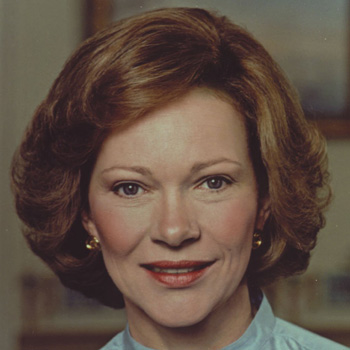
Eleanor Rosalynn Carter
Rosalynn Carter was a political activist First Lady who publicly disclosed the fact that the President consulted her and sought her advice on his domestic and foreign affairs decisions, speeches and appointments. Traveling the nation at length, Rosalynn Carter also served as a liaison of current information between the President and the American public she encountered, providing him with reaction to Administration policy from the citizenry and providing them with explanations of that policy. A consequence of this was her unprecedented attendance at Cabinet meetings where she heard policy discussion first-hand and took notes on issues that she would subsequently carry to the public. She and the President maintained a Wednesday business lunch in the Oval Office to discuss Administration policy on issues that she had taken on as a spokesperson or on legislative matters of concern to her. She was also not averse to disagreeing with the President's final decisions; most often her bone of contention was that Carter did not make decisions or announcements with a sense of timing that always served the Administration's political purposes including issues such as New York City budget cuts, the Panama Canal treaties, and Middle East negotiations.
Rosalynn Carter was the first First Lady to maintain her office in the East Wing, the traditional office space reserved for the social, correspondence, scheduling and projects staff of the presidential spouse. She would often walk outside the mansion to avoid tourists going through the White House, carrying her briefcase with her. Frequently, the First Lady worked directly with Cabinet members, including the Secretary of Housing and Urban Development Patricia Harris and Secretary of Health, Education and Welfare Joseph Califano. In 1979, during her tenure, the federal government more formally recognized the role of First Lady as a bona fide federal position, albeit undefined by the U.S. Constitution, when automatic congressional appropriation was enacted for a staff for the First Lady on the premise that the "spouse assists the president" in fulfilling his duties.
Like her two Republican predecessors, Rosalynn Carter also supported the Equal Rights Amendment and she made appearances in those states where ratification was still pending. Although she also supported the controversial 1973 Roe vs. Wade decision of the Supreme Court, she opposed federal funding for abortion. As the incumbent First Lady, she joined former First Ladies Lady Bird Johnson and Betty Ford in Houston, Texas for the opening session of the Women's Conference in 1977. She successfully lobbied the Pentagon to hire more women to serve as White House honor guards and pushed to have minority women involved at higher levels in the president's re-election staff. She urged the Attorney General to join her call for a woman on the Supreme Court and phoned him to suggest the naming of qualified judge Stephanie Seymour for an Oklahoma court; for the President, she asked her staff to assemble a roster of qualified women for presidential appointments.
In June of 1977, Rosalynn Carter undertook one of the most overtly political international missions ever assumed by a First Lady; she visited Jamaica, Costa Rica, Ecuador, Peru, Brazil, Colombia, and Venezuela as the President's personal representative, holding substantive meetings with Central and South American policy leaders on issues that included human rights, arms reduction, demilitarization, beef exports, pilot training, drug trafficking, nuclear energy and weaponry. After each day's talks, she filed a report with the U.S. State Department. At many of her meetings the First Lady spoke in Spanish, having just previously completed an intensive language course. Throughout the breaks of the "Camp David Accords," peace talks negotiated by the President between Israeli Prime Minister Menachem Begin and Egyptian president Anwar Sadat, Rosalynn Carter was present to provide support and advice as her husband asked of her. As a representative of the President, she attended the inaugurations of new Bolivian and Ecuadorian presidents, as well as the funeral of Pope Paul VI. The First Lady was also the American representative who greeted Pope John Paul II when he made his first visit to the U.S. in 1979. The First Lady frequently sat in on the daily National Security Council briefings held for the president and senior staff. In November of 1979, she learned the details of the Cambodian refugee crisis; starvation and extermination had killed almost half the population of Cambodia and millions of homeless refugees were flocking to the Thailand border to seek food and medicine in large camps set up for them. She flew to see the conditions for herself and successfully urged the United Nations creation of a world relief coordinator. Her influence further prompted the creation of the National Cambodian Crisis Committee and CambodianCrisis Center, which became the clearinghouse for all donated aid; she raised millions of dollars for the cause in the U.S. and got the president to increase U.S. quotas for refugees, permit food delivery directly into Cambodia and to accelerate Peace Corps efforts. With the November 4, 1979 taking of American hostages in Iran, the First Lady urged the President to immediately enact an oil embargo from that nation.
In the more traditional aspects of the First Lady role, Rosalynn Carter sponsored the first poetry festival and the first jazz festival at the White House, the latter being broadcast live on public radio. She also hosted a series of classical music concerts that were broadcasted for the public as In Performance at the White House. Continuing the preservation efforts of her immediate predecessors, she established the White House Trust Fund to create a $25 million endowment top continue building its perpetual historical collection and ongoing renovation needs. At Christmas, Rosalynn Carter hosted a unique winter lawn festival for congressional families, complete with skating rink.