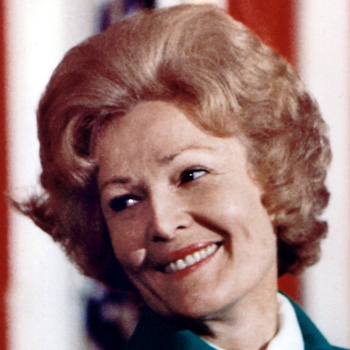
Thelma "Pat" Catherine Nixon
If the public expects a First Lady to reflect the "average" American woman, Pat Nixon faced a challenge when she assumed the post in 1969 - a time when the role of women in American society was being dramatically redefined in both perception and reality. Pat Nixon became the first incumbent First Lady to endorse the Equal Rights Amendment. She was the first to disclose publicly her pro-choice view on abortion in reaction to questions on the Supreme Court's 1973 Roe vs. Wade decision. Before she even began unrelentingly to lobby her husband to name a woman to the Supreme Court, she called for such an appointment publicly. She even became the first First Lady to appear publicly in pants and model them for a national magazine, reflecting the radical change in women's attire that critics derided as masculine. Still, Pat Nixon valued her identity as a middle-class homemaker, supportive wife and devoted mother and was often depicted as the quintessential traditionalist in relief to the popular persona of the "liberated woman."
Recalling her own first contact with the Franklin Roosevelts, Pat Nixon understood how the average citizen and "common man" appreciated a gesture of support for them or their local efforts. She made a conscious effort to emphasize the value of the individual American, an effort that the media often overlooked because of larger, national priorities or derided in an age when previously-held values were being questioned. Her most tangible and immediate response to the individual was through management of her own correspondence. She instructed her correspondence director to send her several hundred of the letters sent weekly by the public to the First Lady, and she spent up to five hours a day either dictating or hand-writing her responses. If a person wrote her requesting federal assistance of some kind, she not only directed the letter to the proper agency but responded through her own office staff, making it function much as a congressional office did in meeting the needs of its constituency.
In line with the Administration's public health and education initiatives, Pat Nixon was a member of the President's Committee on Employment of the Handicapped, and honorary chair of the Department of Health, Education and Welfare's "Right to Read" program. Finally, she also initiated efforts in her own community, of Washington, D.C. such as the "Evenings in the Park," a series of local summer concerts for inner-city youths, hosting one program on the White House lawn, and attending another on the Washington Monument grounds, amid a large number of anti-war and "Black Power" protesters at a simultaneous rally there. Pat Nixon also visited several local day camps for underprivileged children that the private sector supported, and took groups of the children on afternoon voyages on the presidential yacht. For groups of local, disadvantaged children she hosted the first annual Halloween parties in the mansion.
The Vietnam War dominated the first part of the Administration and Americans who either supported or opposed U.S. involvement in Vietnam shadowed many of Pat Nixon’s public appearances. Pat Nixon stated that the actual servicemen who were in Vietnam or who had returned home from the war knew the situation better than anyone else at home; the statement seemed to underline the conflict many Americans felt about the Vietnam War, supporting the concept and the actual troops, if not the devastation of war itself. Vigorously supporting her husband's running of the war and defense of freedom there and saying she would give her own life for the effort, she voiced her support of amnesty for those men who had left the U.S. to avoid the draft. She was also "appalled" at the killing of four antiwar protestors at Kent State University by Ohio National Guardsmen.
While she continued to feel a deep ambivalence about the cost of politics to her personal life, Pat Nixon enthusiastically supported the President's run for a second term in 1972 because she hoped to see congressional action on his welfare reform, environmental and health care reform proposals. She regularly read and marked the Congressional Record, Administration issue papers, studies and reports. Pat Nixon attended the first Nixon Cabinet meeting and at least one domestic briefing given to presidential advisors. In private, she could often offer devastating and pointed critical advice to the President; she did not seek to unravel or resolve a specific political issue but rather to offer a strategic approach to problems he faced. She did not believe, for example, that it had been a wise decision to have the Vice President Spiro Agnew so bluntly attack the national media.
Pat Nixon first learned about the criminal actions that came to be cumulatively known as the Watergate scandal and soon come to engulf the Administration only from the media. She and her daughter had been specifically left uniformed by the President and his advisors of the details of their actions and decisions as they were in the midst of it all. When the First Lady first comprehended the potential damage that the secret tape recordings made by the President could create, she offered the unsolicited advice that he destroy them while they were still legally considered private property - advice he did not follow. While she fully believed her husband was innocent and telling the truth to the American people, she became deeply disturbed by how isolated he became within a small circle of advisors. She had never had a good working relationship with his Chief of Staff Bob Haldeman, and his aide, John Ehrlichman, who had both, at times, sought to overrule decisions of Pat Nixon and her staff; she was relieved when they both resigned in the spring of 1973. When the threat of impeachment became real in late July of 1974, Pat Nixon advised her husband not to resign because of the blanket criminal indictment that might ensue, suggesting instead that he fight each individual article of impeachment. Once he decided to resign, however, she began packing their possessions and making the immediate arrangements for their return to California. He resigned on August 9, 1974.