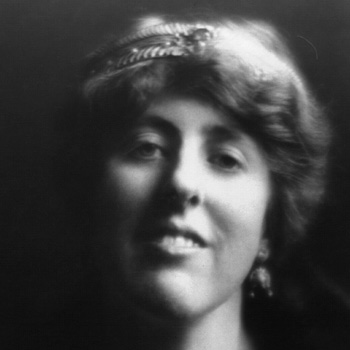
Margaret Woodrew Wilson
During the seventeen months that her mother lived as a presidential spouse, Margaret Wilson was also highly active, already serving as an aide to the First Lady. Living in the White House in a bedroom suite apart from her parents and sisters, she occupied the large suite at the east end of the second floor in what is today known as the Lincoln Bedroom. Furnished in blue, she kept her baby grand piano in a corner of the room and often entertained friends and her family by playing and singing to them there.
Miss Wilson either joined her mother as hostess at public receptions or presided alone at those where her mother was unable to appear. She also assumed responsibility for entertaining the many members of her extended family and other friends and professional associates of the President who stayed at the White House as houseguests. At times, she was beset with insecurity over her social abilities, feeling “inadequate” as a public figure and often left “so distressingly weary” by the demands for her appearances which she nevertheless felt obligated to meet. She nevertheless recognized her privileged life, characterizing it as “wonderful times” in a “wonderful country,” and that her life as First Daughter was worth “all its horrors.” She was entirely at ease, however, in making public appearances and meeting strangers, her sister characterizing her as being “so vividly intelligent and interested in other people” that she moved without self-consciousness in the public arena.
Margaret Wilson worked with her mother on various public welfare issues in Washington, D.C. and at least one area of interest which has been previously associated with Ellen Wilson was likely an endeavor initiated by the First Daughter. On two significant social and political issues, Margaret Wilson’s views conflicted with those of her parents.
It is unclear whether Margaret Wilson acted on her own accord or at the behest of the President or First Lady when she made a stealth visit to the now-estranged Colonel Edmund House, once the President’s closest adviser in December of 1919. During the League fight in the Senate, House had written three letters to the President suggesting he not accept a compromise on his vision of the League and offered vacillating strategies to assure partial passage. Edith Wilson, however, refused to have the letter shown to the President. Attempting to negotiate a repair of the friendship, Margaret Wilson suggested that House’s unsolicited advice had offended her father but he assured her that his only motivation was to see that some form of the League passed not only because it would serve as a foundation for his global legacy but also spare him further stress. Acting as a liaison between the two men, Margaret Wilson carried this message directly to her father’s bedside but Wilson repeated Edith Wilson’s initial assessment of House as being too weak and that any effort for the old friends to again meet would prove “embarrassing for them both.”