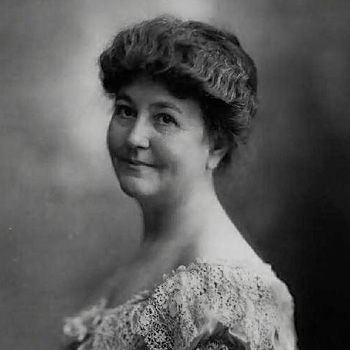
Ellen Wilson
During the transition period following the election and before the inauguration, Ellen Wilson finally turned to her friend and husband’s cousin Helen Bones to aid her as a personal secretary, a role she continued in the White House [see biography of Helen Bones as surrogate First Lady below]. As First Lady, she also rehired Isabelle Hagner to be the Wilson Administration Social Secretary, asking her to repeat the official and federally-salaried position she first originated in 1901 for Edith Roosevelt. Hagner established her working office in the West Sitting Hall, in the family quarters, and it became a central focal point for the President, First Lady and their three adult daughters at the beginning and end of each day. Ellen Wilson made news when she went to a public photographer’s studio to pose for her formal portrait in a gown she had intended to wear to the cancelled Inaugural Ball, rather than request the photographer to capture her seated in the White House; this move symbolized an egalitarian gesture of the new Democratic Administration.
During her first full three months as First Lady, from March until June of 1913, Ellen Wilson hosted over forty White House receptions, with an average guest list of 600. Although both she and the President initially appeared on the receiving lines, it was the new First Lady who endured these to the end, at great expense to her health. As far as the slight derision the press suggested about her sense of fashion style, Ellen Wilson cared little. Bragging that she spent less than one thousand dollars a year on clothes, one newspaper columnist added sarcastically, “and she looks it.”
Ellen Wilson found escape from her social obligations by often attending the theater or the new silent “movies,” also beginning to be shown in public theaters. She further made visits to the local art galleries and museums. From the Corcoran Gallery, she had a famous canvas by artist George Watts, “Love and Life,” which pictured two nude women returned to the White House, which owned it. Edith Roosevelt had also displayed the painting in the private quarters, although Nellie Taft had sent it to the public museum.
Ellen Wilson’s greatest legacy as First Lady was her commitment of service and support to a public welfare project intending to provide assistance to an otherwise ignored demographic. It was an effort she began eighteen days after becoming First Lady, when on 22 March 1913, she had a meeting with Charlotte Everett Wise Hopkins, the chairperson of the Women’s Committee of the National Civic Foundation’s Washington branch. A civic activist in Washington for several generations, Hopkins had first successfully engaged a First Lady in local issues when she convinced Frances Cleveland to support an annual charity Christmas party for the children of the African-American working-class in the nation’s capital city. The widespread and deplorable housing of this same demographic was the concern of Charlotte Hopkins when she convinced Ellen Wilson to join her effort to reform this problem.
Ellen Wilson’s political influence on the President is believed to have been less about her raising issues with him than he seeking her opinion. According to their daughter Nell, he reviewed not only all of his important political speeches with her but “every important move.” His Treasury Secretary believed that Ellen Wilson was “the soundest and most influential” of the President’s personal advisers. Like Ida McKinley, Ellen Wilson did successfully help place several individuals who sought her intercession in their gaining federal positions of postmasters and postmistresses. She was unsuccessful in her effort to coax the President’s choice for Ambassador to Germany to accept the offer of the position. She seemed to have been a positive reinforcement behind his decision to become the first chief executive since the Federal Era to personally deliver the presidential “state of the union” report as a speech before Congress, joking that it was just the sort of innovation that former President Theodore Roosevelt would have done, “if he had thought of it.”
Ellen Wilson became the third presidential wife who died in the White House, following Letitia Tyler in 1842 and Caroline Harrison in 1892. Initially, the First Lady’s remains were rested on her White House bed. Four days after her death, a private funeral service was held for her in the East Room of the White House. Floral arrangements from around the world lined the entire east and west walls of the long room.