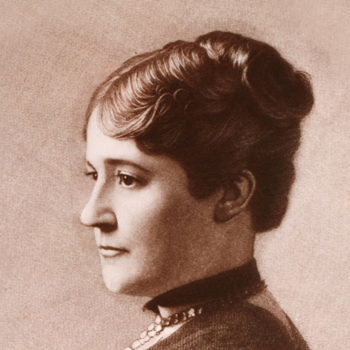
Mary Arthur McElroy
Chester Arthur’s desire to have his daughter Nellie now live permanently with him in the White House was the determining factor which led to the girl’s supervisor, his sister Molly McElroy, serving as his First Lady, but tracing the progress of her presence evidences that he came to appreciate the value of a designated First Lady. Yet even one full week after she had first arrived on January 14, with her eldest daughter May, the press reported that she was only “visiting,” and “may not remain long,” preferring her “books” over an active social life.
As the 1883 social season got underway, however, Molly McElroy neither returned to Albany– nor was asked to by the President. On January 24, she received guests with the President at a diplomatic corps dinner, seated beside the Haitian Ambassador, directly across from the President, who had placed her in a visible spot with the protocol rank of a Chief Executive’s family member. She again received guests with him at a formal dinner two days later, and the next morning she hosted her own first afternoon reception.
Standing in front of the oval divan in the Blue Room, she began to host a weekly public reception on Saturdays, largely for women who worked weekdays and would otherwise have been unable to meet her. She also received delegations such as the Psi Upsilon Society along with the President, and was the most prominent figure among numerous officials on a Sunday presidential cruise down the Potomac. She also began taking advantage of the presidential box at the theater, including a 27 January 1883 performance of “Patience” that included the extremely rare instance of the President attending Ford’s Theater, where Lincoln had been shot.
Molly McElroy’s unusual status whetted interest in Washington. Any bit of information about her was eagerly sought. An initial description only provided a physical composite: “…she resembles the President only about the eyes…she has a dainty, petite figure, being both short and slight, and is pale as if she did not enjoy the best of health. She is very modest…” Soon enough she was being feted as the guest of honor at luncheons hosted by the curious wives of the Chief Justice and Secretary of State and she began to garner more attention than the President when she joined him at dinners in the homes of Cabinet members. Without the status of a presidential spouse, she felt unbound by the unwritten social coda that had dictated the social interactions of her predecessors who had been wives, and she freely attended social events in private homes.
Her tendency toward caution was a matter of striving to avoid saying or doing anything which could be misinterpreted or reflect poorly on the President. She later reflected that, “When I went to the White House, I was absolutely unfamiliar with the customs and formalities.” While she resisted being drawn into any actions that could be perceived as political, some of her decisions as hostess did carry direct political implications. Molly McElroy politely resisted lobbying efforts from the Women’s Christian Temperance Union to influence the President to re-enact the Hayes ban on alcohol, or even to make a personal declaration that she would not imbibe in any spirits either in private or public at the White House. After enjoying an August 1884 respite with the President, his children and her own family at Lake Mohonk ,New York, Molly McElroy returned with Nellie and the President to the Soldier’s Home a few weeks later. She remained there for two months, staying to celebrate Thanksgiving with the Arthur family, then returning to her own family in Albany for Christmas.
At the 1885 New Year’s Day reception, she took her place in the East Room, wearing violet satin, beside her brother in his Prince Albert-style suit, his spectacles dangling from a black silk thread, a rosebud in his button hole, and a pearl pin holding his black satin scarf. For the first and only time, he finally permitted the general public see and to meet his daughter. Dressed in white, the now-thirteen year old First Daughter Nellie Arthur stood in the Green Room at the head of a receiving line that included her cousins May and Jessie, and schoolgirl friends.
Several weeks later, at her last public reception, the curiosity and popularity that Molly McElroy had unwittingly generated by the unusual circumstances of her becoming First Lady, prompted an unexpected mob scene. The White House was overcome with 3,000 people – as many men as women, including Adolphus W. Greely, Arctic explorer and a celebrity of the era. So jammed were the doors and halls, that people were found entering from the basement kitchen doors, and over boards through the windows. One Senator entered through the front door, but descended the servant staircase, walk through the garden, ascend the back portico stairs and then enter through a window in the Blue Room. The musicians in the hall were literally pushed from their places in the corridor.
n the first days of March 1885, despite the fact that their brothers led the opposing political parties, Molly McElroy formed a friendly alliance with her incoming successor Rose Elizabeth Cleveland, sister of bachelor president-elect Grover Cleveland. The unusual transition generated particular notice as the only time in history when the only two presidential sisters to serve as First Ladies succeeded each other. A further curiosity was that both women were residents of Albany. When Molly appeared at the Cleveland Inaugural ceremony only to find the seat reserved for her taken by Rose, the latter relinquished it for the former. Some two hours later, Molly McElroy hosted a final White House luncheon, to honor Rose Cleveland.