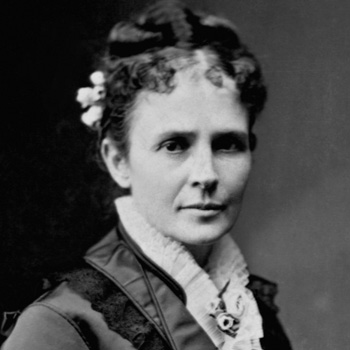
Lucretia Garfield
Initially uncomfortable with the public scrutiny that came with being First Lady, Lucretia Garfield soon proved herself decisive regarding the many aspects of the traditional role that she faced. She resisted pressure from Ohio Republican and temperance colleagues of her husband and refused to continue the total ban on alcoholic beverages in the White House that had been initiated by the Hayes Administration, and even confessed to her husband that she often drank some wine in the evening to relax. A notation in her papers suggests that she intended to invite celebrated writers, artists and musicians to the White House as dinner guests.
As individuals she met often shared their memories and stories of past Presidential families with her, an interest in the mansion's history was sparked in Lucretia Garfield. She intended to conduct a redecoration of the White House that would include an effort to recreate some historical ambience that recalled the earlier residents of the mansion, and went with the President to the Library of Congress to conduct some preliminary research on what the rooms had once looked like. She also made at least one independent trip to New York to see decorators and also found herself on that trip the unwitting object of public attention that rapidly drew a crowd.
As individuals she met often shared their memories and stories of past Presidential families with her, an interest in the mansion's history was sparked in Lucretia Garfield. She intended to conduct a redecoration of the White House that would include an effort to recreate some historical ambience that recalled the earlier residents of the mansion, and went with the President to the Library of Congress to conduct some preliminary research on what the rooms had once looked like. She also made at least one independent trip to New York to see decorators and also found herself on that trip the unwitting object of public attention that rapidly drew a crowd.
Whatever public cause she may have intended to support, her active public role came to a sudden halt in early May of 1881 when she contracted malaria and nearly died in the White House. The President recorded that he found himself unable to conduct the affairs of government, so distracted was he at the mere thought of her demise. He took a larger role in overseeing the tutoring and play life of their children. Although his elderly mother had returned to her own home sometime after the Inaugural in March, there was public speculation that she might return to Washington and help manage the lives of her young grandchildren and even substitute as a hostess at formal dinners alongside her son if the First Lady did not seem to fully recover by the fall.
Several days before she contracted her illness, Lucretia Garfield had welcomed among her guests at an open reception one Charles Guiteau, an unhinged adherent of the Stalwarts, most frequently identified as a disappointed office-seeker. He found her "chatty and comfortable." Once she began to recover, Lucretia Garfield was sent to the New Jersey seaside, at Elberon, where it was thought that the salt air would be conducive to her recovery. Escorted to the Washington train station by the President, she appeared so weak and thin that Guiteau could not bring himself to shoot Garfield, as he had intended, wishing to spare the First Lady the anguish of witnessing his possible assassination Guiteau delayed shooting the President out of concern for the First Lady. (Library of Congress) .
Guiteau did shoot Garfield on July 2. Lucretia Garfield rushed back to Washington to nurse him and take charge of the White House, showing a remarkable calm and courage that won her widespread admiration. Throughout the long months of his lingering life, the nation's newspapers reported in detail how the First Lady managed herself and encouraged the President, often idealizing her and ignoring her genuine fear and weariness. Rallying her own precarious health, as she had barely recovered from malaria, the First Lady was often seen depicted as going down into the White House kitchens herself to prepare some special food intended to heal his wounds or fight off infection.
The President was moved to Elberon in an attempt to make him more comfortable and to help his recovery. The move was fruitless. James A. Garfield died September 19, 1881 with his wife, Lucretia, and daughter, Mollie, at his side. Lucretia took over the funeral and burial arrangements The widowed First Lady depicted at the deathbed of President Garfield. (Leslie's Magazine) .