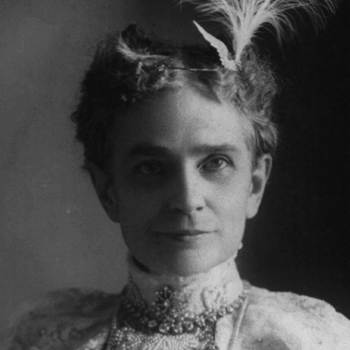
Ida Saxton McKinley
Rather than permit her various health conditions to limit her role as First Lady, Ida McKinley adapted them in fulfilling what she believed was her duty as a president's wife. he received guests seated in a large armchair rather than stand alongside her husband at receptions. The seating protocol at formal dinners was changed to permit her to be placed beside her husband rather than across the table from him.
AIda McKinley did not chose any one particular public issue or cause to focus her efforts on as First Lady. She did, however, limit her personal support to two particular organizations. One was Crittenden House, an organization which maintained several centers around the country which served as a place for homeless, indigent and unemployed women to seek temporary shelter, nutritional meals and educational training for an employable trade. The other was the American branch of the Salvation Army, led by the British organization's founder Evangeline Booth, who became a close friend of the First Lady.
As First Lady, she sponsored a number of unique musical events at the White House and initiated the innovation of providing entertainment to guests after formal dinners. The first evidence of the new musical genre of ragtime being heard in the White House dates to a Valentine's Day dance she hosted.
Following the explosion of the U.S.S. Maine in Havana harbor, Cuba and the declaration of war against Spain in 1898, Ida McKinley exercised a greater degree of influence on the President. According to several sources, she had been steadily providing him with keen assessments of early drafts of his speeches and the character of those individuals ambitious for appointments. She was influential in seeing to some minor appointments as well as at least two mid-level ones, including the oversight of immigration and of western territory.
Although Ida McKinley visited Niagara Falls with the President during their trip to Buffalo, she avoided all of the Exposition venues due to the large numbers of crowds there. She was therefor not with her husband when he was standing in a public receiving line at the Temple of Music and shot by anarchist Leon Czolgosz on September 9, 1901. During the six subsequent days when it seemed that he might recover, Ida McKinley displayed remarkable physical and emotional strength. Once it was clear that the President would not survive, her physician and those treating the President permitted her to see him one final time, but prevented her from being with in the moments before he died.