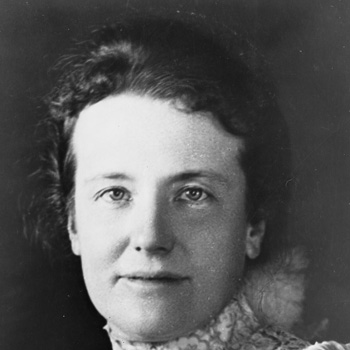
Edith Roosevelt
Edith Roosevelt’s first order of business as First Lady was to adapt the limited space appropriated for the family living quarters to her own large family. Since this was located at the western end of the second floor where the executive offices were also located, at the eastern end, she had great motivation in approving the tremendous structural change which took place at the Executive Mansion, which her husband officially changed to “the White House.” The greatest shift in life resulting from these renovations of 1902 was the creation of a West Wing to house the executive staff offices, thus making the second floor entirely the private domain of the family. New woodwork and lighting, a plumbing and heating system were also added.
Having had an interest in the White House and having known Frances Cleveland,. Edith Roosevelt did not view the mansion as merely the home of her family but the representation of the nation. Edith Roosevelt worked with her husband in guiding the symbolic look of the public state rooms, matching the new status of the United States on the world stage as a leading power.
Edith Roosevelt hosted not only the traditional schedule of winter and spring formal dinners, the special dinners held to honoring visiting heads of state, the larger, general receptions and the innovative afternoon musicals she hosted. These were especially noteworthy, for among the composers and musicians were Ignace Jan Paderewski and Pablo Casals.
More than any aspect of being First Lady, Edith Roosevelt despised having her privacy and family life exposed to the public through the press. She steadfastly refused to grant interviews to reporters and even resisted having her clothing described for press stories of what she wore to public events. In fact, she often wore the same outfit but it was ingeniously described in different ways to suggest that she had a larger trousseau than she did. Edith Roosevelt’s one concession to the press was to have her children pose for the city’s renowned photographer Frances Benjamin Johnston, often with many of their beloved animal companions, and publicly release these for use in newspapers and magazines, there being a voracious public interest in the presidential children
Edith Roosevelt also played a limited but important political role as First Lady. Unlike her immediate predecessors Lucy Hayes, Frances Cleveland, Caroline Harrison and Ida McKinley, for example, she did not join the President on his transcontinental public train trips to the western part of the country. She did make an official trip with him to Georgia and to the Panama Canal, then under construction.
Edith Roosevelt’s most important role in policy was to serve as a conduit between their trusted friend, Cecil Spring-Rice, a British government representative whose junior status prevented his being appointed the official Ambassador to the U.S. It focused largely on the deteriorating relationship between Japan and Russia. Spring-Rice was able to privately exchange information about the conflict with the President by writing to the First Lady at the White House, thus making the correspondence entirely private, but which she then passed on to her husband. One of Theodore Roosevelt’s greatest accomplishments was negotiating the Russo-Japanese War, for which he was awarded a Nobel Peace Prize in 1906
She never lost a fear of harm coming to the President, conscious of the threats made by anarchists at the time to the lives of many world leaders. When she found and appropriated a small cottage in Albemarle County, Virginia for use as a presidential weekend retreat, Edith Roosevelt instructed a Secret Service agent to guard the President there from a distance, and without his knowledge.