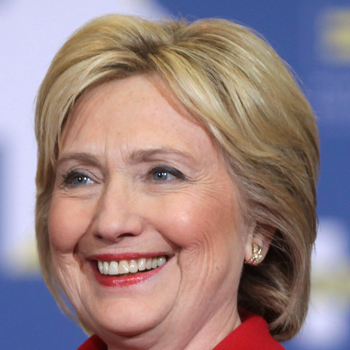
Hillary Diane Rodham Clinton
The first decision Hillary Clinton made, as First Lady was to establish her own working office in the West Wing. She did this in order to be accessible to executive staff working on legislative and other substantive matters in which she would herself be directly involved. Doing so shattered historic precedent, all of her predecessors having worked from offices located in the second floor family quarters or, in the case of Rosalynn Carter, in the East Wing.
During the transition period, Hillary Clinton began to assemble a staff that would work with her for varying periods of the duration of her eight years as First Lady. Many would also continue to work with her as a United States Senator and then as a Secretary of State. During the 1992 campaign, one of her aides, Patti Solis Doyle, responded to a call with "Hillaryland," and the reference to those who worked with her became a catchphrase used to describe her White House staff. The staff was composed largely of women, but not exclusively, who had experience working for public interest and public service organizations. With her being so involved in policy, her staff was more fully integrated into the workings of the West Wing than that of any previous First Lady.
Within the first five days of becoming First Lady, Hillary Clinton was named by her husband to head the President's Task Force on Health Care Reform, overseeing research, investigatory trips, financial reports, numerous committees composed of medical and insurance professionals, lawmakers and other government officials, public service leaders, and consumer rights advocates. When most of the meetings were conducted behind closed-doors, however, opposition was raised that it violated the government's so-called "sunshine laws" that required full public disclosure. There then ensued a legal debate on whether the unsalaried and unofficial role of a presidential spouse held a person in such a role to the same standards as a federal employee. In this capacity, she became the third First Lady to testify before Congress, appearing to the House committee on health insurance reform in September 1993.
Having a West Wing office allowed the First Lady greater and regular access to the President and his senior staff. With her familiarity with the intricate political issues and decisions faced by the President, she openly discussed his work with him, yet stated that ultimately she was but one of several individuals he consulted before making a decision. They were known to disagree. Regarding his 1993 passage of welfare reform, for example, the First Lady had reservations about federally supported childcare and Medicaid. However different their solutions might be on how to best address an issue, the Clintons were nevertheless united in believing that it was important to resolve and would join in the agreed method of tackling it. When issues that she was working on were under discussion at the morning senior staff meetings, the First Lady often attended. Aides kept her informed on all pending legislation and oftentimes sought her reaction to issues as a way of gauging the President's potential response.
Weighing in on his Cabinet appointments and personally familiar with the experience of individuals appointed by the President, the First Lady developed a working relationships with many of them on issues of joint concern and also lobbied them on behalf of departmental changes.
During the Lewinsky scandal, Hillary Clinton supported her husband's contentions of innocence regarding marital infidelity, believing the rumors, along with the other charges, to be the result of a "vast right-wing conspiracy." In August 1998, however, when independent counsel Kenneth Starr questioned the President directly in the White House, he confessed that he had lied regarding the extent of the affair. Hillary Clinton later admitted to being deeply wounded personally yet focusing on the public repercussions of the President's disclosure, made a strong statement of commitment to him and the Administration, believing a private matter had been wrongly turned into a political attack. Her support of him at that critical juncture was believed by many media commentators at that emotionally heightened time to be an important factor, if not the greatest factor, in preventing a call for his resignation.
In 2000, Hillary Clinton addressed the Democratic National Convention, held in Los Angeles, marking her second time doing so. She would go on to do so again in 2004 and 2008 as an incumbent Senator, then again in 2016, thus sharing the record with Eleanor Roosevelt who also spoke at five conventions. She did not participate in the 2000 presidential campaign of Democratic nominee Vice President Al Gore.
On November 7, 2000, Hillary Clinton became the first First Lady elected to public office, winning the U.S. Senate seat from New York State with 55% of the vote to Lazio's 43%.