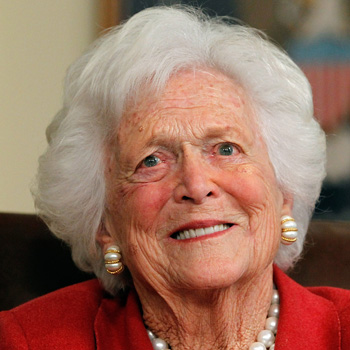
Barbara Bush
The hallmark of Barbara Bush's tenure as First Lady was her focused campaign to bring national attention to, and help eradicate illiteracy in America. Having been involved in the issue for eight previous years as the Vice President's wife, she was not only able to immediately begin her efforts following the Inauguration, but had already a national network of support in place, consisting of experts, publishers, financial supporters, volunteers, school administrators, and national, state and local civic leaders. Early in the administration, Barbara founded the Barbara Bush Foundation for Family Literacy, a private organization that solicited grants from public and private institutions to support literacy programs. "I'm talking about the big, bouncy kind [of family], the single parent, extended families, divorced, homeless and migrant," she clarified. At the time of her tenure, statistics showed that 35 million adults could not read above the eight-grade level and that 23 million were not beyond a fourth-grade level. She appeared on the Oprah Winfrey Show addressing the issue, and made regular broadcasts on Mrs. Bush's Story Time, a national radio program that stressed the importance of reading aloud to children. One aspect of adopting literacy as an issue that provided Barbara Bush with an opportunity to address a wide variety of topical issues was, as she pointed out, that a person's inability to read or fully comprehend what they might be able to partially read could have a devastating impact on all elements of their lives: education, employment, housing, safety, health, parenthood, crime, travel. She did go on record as stating that she did not believe there should be a law that established English as the official language of the United States because she felt it had "racial overtones." Thus she was able to address many social problems that were unique to the era of her husband's presidency of the early 1990's like homelessness, AIDS, and teenage pregnancy.
During her first week in the White House, Barbara Bush brought national attention to the needs of indigent and homeless families by making a visit to "Martha's Table" an inner-city center providing meals for poor families and daytime and after-school activities for homeless children, and also running a mobile soup-and-sandwich kitchen through the streets of Washington. She donated her family's used clothing to thrift stores which raised money for charitable organizations and also offered low-cost resale to the needy. Often visiting homeless family shelters, Barbara Bush also publicly raised an issue that was rarely considered in coping with the problem - abandoned, single, unmarried mothers, many of them teenagers, who were receiving no help from the fathers of the children. Although she assumed the traditional view of the Republican Party that social programs were best funded and administered by private charities and organizations rather than by the government, she was not averse to claiming government responsibility in some cases, once remarking at a center for homeless children, "forget about government cutbacks." Barbara Bush made the front page of many global newspapers when, during a visit to "Grandma's House," a pediatric AIDS care center, she held a baby infected with the virus and posed for photographers to record what was then an act that was often misunderstood as making one susceptible to contracting it. She then went to hug an adult with AIDS as well. She took the President to the National Institute of Health to meet with male patients who had AIDS, and attended the funeral of the heroic teenager Ryan White who succumbed to AIDS after leading a long public education campaign on the issue. When there was an AIDS memorial vigil where gatherers held candles, she placed candles in all the White House windows and asked several family members of those who had died of the illness to bring to her in the White House parts of a national AIDS quilt that was then on display on the national mall. Although she told the press that because of the federal deficit, increased funding was an issue the President would have to decide, Time magazine credited Barbara Bush's concern for those with AIDS for influencing the President to propose increased research and treatment funding. She was further credited as being the inside advocate for the President's signing of the Hate Crimes Statistics Act and invited the first openly gay and lesbian citizens to the presidential signing ceremony. She wrote to the president of the Federation of Parents and Friends of Lesbians and Gays, "I firmly believe we cannot tolerate discrimination against any individuals or groups… [it] always brings with it pain and perpetuates hate and intolerance."
During the Bush Administration, the fall of communism came to the Soviet Union and there were global repercussions, often prompting the Bushes to travel overseas and entertain many foreign heads of state. Humorously, when she met the spouse of British Prime Minister Margaret Thatcher and he kissed her hand, Barbara Bush responded by kissing the hand of Denis Thatcher. A strong supporter of the Gulf War waged by her husband, Barbara Bush spent a Thanksgiving holiday with him among U.S. troops stationed in Saudi Arabia.
Her time in the White House was also marked by personal challenges. She believed that her son Neil became a target of investigators looking into the demise of the Silverado Savings and Loan during the Savings & Loan Crisis because he was the President's son. Her daughter Doro divorced at the beginning of the Administration and moved to be near her parents, in Washington; towards the end of their term, she remarried at Camp David, to Robert Koch, former aide to House Democratic leader Richard Gephardt. In the closing days of the President's failed re-election campaign, Barbara Bush's mother-in-law Dorothy Bush died at her Florida home.