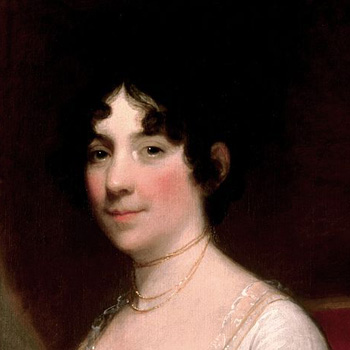
Dolley Madison
She fortified her role of hostess by the visual effect of both the executive mansion and her own person, redecorating the public rooms in a style grand enough to impress foreign diplomats and dressing in a regal, yet simple manner. She used her clothing style to make herself visibly distinct and define her own public identity, most notably by her trademark turban.
Dolley Madison was the first First Lady to formally associate herself with a specific public project; as a fundraiser, supporter and board member, she helped to found a Washington,D.C.home for young orphaned girls. She also befriended nuns from a local Catholic school and began a lifelong association with the organization.
To a degree larger than even Martha Washington, with whom the public had been familiar since the American Revolution Dolley Madison became a genuinely public celebrity. She was often referred to as “ Lady Madison, ” honored by having a ship named for her, being solicited by authors to help promote new books, and even depicted on a magazine cover.
Her legend was made lasting, however, by her conscious act of symbolic patriotism in the hours preceding the burning of Washington by British troops during the War of 1812. She famously refused to leave the White House before being assured that the large portrait of George Washington was removed from the walls and taken safely away from potential destruction or defacing by the encroaching enemy.
Finally, there is the suggestion that it was Dolley Madison who urged both the President and Congress to keep Washington as the capitol city, rather than permit it to be returned to Philadelphia. Contemporary accounts do record her rage at the British for burning her favorite city and she did resume her entertaining as a symbol of rebirth in Washington, in the two buildings that she and the President occupied in the capital for the duration of his Administration.