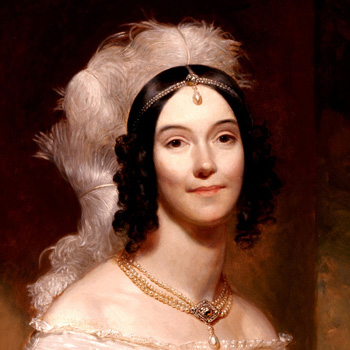
Sarah Angelica Van Buren
Days after her wedding ceremony in South Carolina, Sarah Angelica Van Buren proceeded to Washington with her husband, and moved into his suite at the White House where he worked with his brothers Martin and Smith as one of their father’s private secretaries. Settling into the presidential household just as the 1838-1839 social season began, the beginning her tenure as First Lady for more than half of the Van Buren Administration. The President’s new daughter-in-law was escorted by him into formal dinners and seated with the place of honor as the woman of highest-ranking, a status that would have been accorded a wife. She received the general public at the 1839 New Year’s Day Reception, receiving people in the oval state room (not yet decorated in blue or so designated by that color). A Boston Post reporter observing her behavior at the event noted that she was “free and vivacious in her conversation” and believed she was “universally admired” by the public crowds which met her. He assessed her as being “a lady of rare accomplishments.”
Winning praise during her initial period as First Lady in 1838-1839, Sarah Angelica Van Buren modeled her public conduct and followed the societal regulations established by Dolley Madison, evidence that she consciously sought this advice from her mother’s cousin being a rather breathless March 8, 1839 note which she sent by messenger to the former First Lady, writing “I am very anxious to see you for a few minutes top consult with you on a very important matter.
After spending the summer with her family in South Carolina, Sarah Angelica Van Buren returned to live in the White House in the fall of 1839 with her husband in time to preside over the start of the 1839-1840 social season. At the 1840 New Year’s Day Reception, however, she employed a more formal manner of receiving guests from the previous year, emulating the “tableaux” technique she had seen in the British and French palaces. While neither seated on a specially-designated “throne” type of chair nor wearing a jeweled head-dress, she did pose while seated, holding a flower bouquet and set back from the public which expected the more traditionally democratic greeting of a handshake. It won her the praise of French Minister Adolphe Fourier de Bacourt, who was generally critical of Americans, he remarking that "in any country" Sarah Angelica Van Buren would "pass for an amiable woman of graceful and distinguished manners and appearance."
Her tableaux form of receiving at the 1840 New Year’s Reception, however, was almost certainly her last public appearance for the year since she was then five months pregnant and social convention dictated that pregnant women be “confined” in private. Her child, a daughter named Rebecca, was born in the White House on 27 March 1840, but only survived for five days. Little is known about Sarah Angelica Van Buren’s pregnancy except that the last trimester was concurrent with the start of the President’s bitter 1840 re-election campaign. In June, she returned to make her annual summer visit to her family in South Carolina. Although she returned to the White House that fall, she became pregnant a second time in October of 1840 and it seems unlikely that she made any but the briefest and most perfunctory public appearances during the coming social season from December 1840 to March 1841. She nevertheless figured tangentially in the campaign.
The United States was then suffering an economic depression. Sarah Angelica Van Buren's receiving style of forming a tableaux, as well as the anecdotal claim that she hoped to have the White House grounds improved to replicate those she had seen at the royal houses of Europe were fodder for a famous political attack on her father-in-law by a Pennsylvania Whig Congressman Charles Ogle. Ogle referred obliquely to Sarah Angelica Van Buren as a member of the president's household in his famous "Gold Spoon" speech. The attack was delivered in Congress and the general depiction of the President as being monarchial in his lifestyle contributed to his failure to achieve re-election during the 1840 campaign.