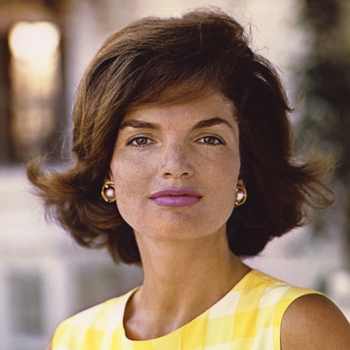
Jacqueline Kennedy
Jacqueline Kennedy entered the role of First Lady by declaring that her priorities were her young children and maintaining her family's privacy. Nevertheless, during the weeks before the inauguration, she began her plans to not only redecorate the family quarters of the White House but to historically restore the public rooms. She created a committee of advisors led by Americana expert Henry Dupont, with sub-committees led by experts on painting, furniture and books. By March 1961, Jacqueline Kennedy was scouring government warehouses in search of displaced White House furnishings, and soliciting the nation to donate important historical and artistic items. As part of this effort, she successfully pressed Senator Clint Anderson and the 87th Congress to pass what became Public Law 87286 that would make such donated items the inalienable property of the White House. Since the restoration project was privately funded, she helped to create a White House Historical Association, an entity which was able to raise funds through the sale to the public of a book she conceived, The White House: An Historic Guide. She also successfully pressed for the creation of the federal position of White House Curator to permanently continue the effort of protecting the historical integrity of the mansion. Her legacy of fostering an national interest in historic preservation extended to her own "neighborhood," when she reversed a previous federal plan to destroy the historic Lafayette Square across from the White House and helped to negotiate not only a restoration of old buildings there, but a reasonable construction of new buildings with modern use.
Jacqueline Kennedy also sought to use the White House to "showcase" the arts. She became the most prominent proponent for the establishment of the National Cultural Center in the nation's capital, eventually to be named for her husband. At the White House she hosted performances of opera, ballet, Shakespeare and modern jazz, all performed by American companies. After her meeting with French Minister of Culture Andre Malraux in May of 1961, he made a loan to the U.S. from France of the Louvre Museum's famous Mona Lisa painting, and Jacqueline Kennedy presided over the unveiling. From Malraux, she developed ideas on the eventual creation of a U.S. Department of the Arts and Humanities, an undertaking she discussed with Rhode Island Senator Claiborne Pell and one that she anticipated would emerge with the creation of a presidential arts advisor and advisory board in 1961. The eventual creation of the National Endowment for the Humanities and the Arts achieved her goal, she later reflected.
Contrary to the image of "lovely inconsequence" that her friend, historian Arthur Schlesinger characterized her as feigning, Jacqueline Kennedy had an intense interest in the substantive issues faced by the Administration; she kept this covert, however, believing that public knowledge of her views would distract from the uncontroversial historic and arts projects she adopted. Privately, she was known to provide the President with withering assessments of political figures with whom he was negotiating, whether it was Pentagon brass or the Soviet Politburo. After the Bay of Pigs, Jacqueline Kennedy made a speech in Spanish, in Miami, December 1962, to the brigade of Cuban fighters who had landed in Cuba to carry out the ill-considered operation. Throughout the days of the Cuban Missile Crisis, she remained at the President's side and he kept her informed of each top-secret move that the U.S. and Soviet Union were making; afterwards, in thanks for the emotional support she provided to him, he presented her with one of the same silver calendars commemorating the crisis that he gave to his military advisors who had helped him. As the fight for civil rights of African-Americans gained momentum, the First Lady illustrated a subtle support for it; when she created a kindergarten in the White House for her daughter and a few select youngsters, it was racially integrated and photographs of the group were publicly released. Jacqueline Kennedy made more international trips than any of her predecessors, both with the President and on her own: France, Austria, England, Greece, Venezuela and Colombia in 1961, India, Pakistan, Afghanistan, Italy and Mexico in 1962, Morocco, Italy, Turkey, Greece, France in 1963. On many of these trips, she forged personal friendship with world leaders, including France's Charles DeGaulle, India's Jawaharlal Nehru, Pakistan's Ayub Kahn, England's Harold McMillan, subtly furthering the interests of the President and the U.S. In South American nations, for example, she made speeches in Spanish hailing the promise of the Administration's Peace Corps. Believing that Kennedy's most important accomplishment was his 1963 Nuclear Test Ban Treaty, days after his assassination she penned a remarkable letter to Soviet Premier Nikita Khrushchev, calling on him to remain committed to nuclear arms reduction and urge smaller nations to do likewise.
Often sketching designs for her clothing as First Lady, Jacqueline Kennedy fashion immediately drew international attention; more than any other First Ladies her style was copied by commercial manufacturers and a large segment of young women. While she appeared largely in the media in unauthorized wire service photographs and "paparazzi" snapshots, White House photographs were more frequently issued to the press than ever before and the role of the official in-house photographer was instigated as a result of Jacqueline Kennedy's own interest and instruction. She also made several television appearances, the most prominent being A Tour of the White House with Mrs. John F. Kennedy, aired on CBS on February 14, 1962. It was the first glimpse into her restoration project and the most sustained exposure the nation had to this youthful and unique First Lady. The television special only further fueled media attention on her and she soon became the first First Lady to find herself on the cover of thousands of popular magazines. The first First Lady to also have her own press secretary, her visibility would permanently forge the media interest in the activities of the presidential spouses.