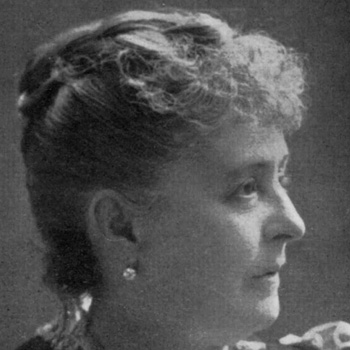
Caroline Harrison
Caroline Harrison’s tenure as First Lady was overshadowed by her predecessor and her successor: Frances Cleveland. Mrs. Cleveland’s youth made Caroline Harrison seem older and more staid than she really was. In actuality, Caoline Harrison was more involved in women’s issues and was more radically inclined than her younger counterpart. Caroline had electricity installed in the White House and made up very detailed plans to enlarge the existing building by adding an east and west wing facing two art galleries. Due to political timing, her plans were narrowly defeated. She did, however, change the west wing by adding a bathroom and converting a bedroom into two rooms. Caroline was horrified at the filth and clutter, and cleaned out all the rooms including the kitchen, which she also modernized. She had floors refinished and rooms wallpapered, all of which met with Frances Cleveland’s approval upon her return in 1893. As
First Lady, Caroline Harrison made china painting popular. She brought Paul Putzki with her to Washington and opened classes in china painting to anyone who wanted to learn. Her interest in china led her to catalog past administration’s china. She also had a china cabinet especially made for the collection. She designed her White House china using a motif that included ears of corn and the goldenrod. Caroline went with the President on his trip to California in April/May, 1891 and planted a tree at the site of the future Stanford University. In 1890, the newly formed Daughters of the American Revolution asked her to become their first President General, which she accepted. Instead of it being an honorary position as she thought, it became a full-time job. Her tact, energy and humor saved the organization from destruction from both internal and external factors. In February 1892, Caroline gave the first recorded speech ever given by a sitting First Lady at the first Congress of the DAR. When John Hopkins Hospital asked her for her support for the creation of a new hospital wing in Baltimore, she refused – unless they agreed to admit women. They did, and she hosted receptions and fund raisers for them. She did a painting of orchids, turned it into a print and made it available to "women and girls" of America. The White House conservatories blossomed during her tenure. Her grandchildren, "Baby" Benjamin McKee, his sister and Marthena Harrison, had a grand time at the White House, but Caroline worried about their safety. Even though Caroline’s sister died in early December 1889 in the White House, Caroline still went ahead with her plans for the first Christmas tree in the White House’s history. She had Sousa and the Marine Band play and, for the first time since Sarah Polk was in the White House in 1845, there was dancing in the White House.
The only real criticism Caroline ever received was for supposedly accepting a bribe – she accepted a cottage at Cape May Point in New Jersey from Postmaster General John Wannamaker. Caroline and the President paid him $10,000 for the cottage to assuage the public outcry. Mrs. Harrison accompanied her husband to the Centennial celebrations of the presidency in 1889 and even christened a battleship, the U.S.S. Philadelphia. By the summer of 1892, she was very ill and depressed. The illness and depression may have caused her to image that her husband was falling in love with her niece and secretary, the widow Mary Lord Dimmick. She later regretted her feelings. Her illness was diagnosed as tuberculosis. A summer in the Adirondack’s failed to restore her to health. In September the President brought her home to the White House, where she lapsed into semi-consciousness. When her husband asked if there was anything they could do, she smiled and said, "No, dear."